Core Advantages of the Top Three Countries in Global Innovation Rankings
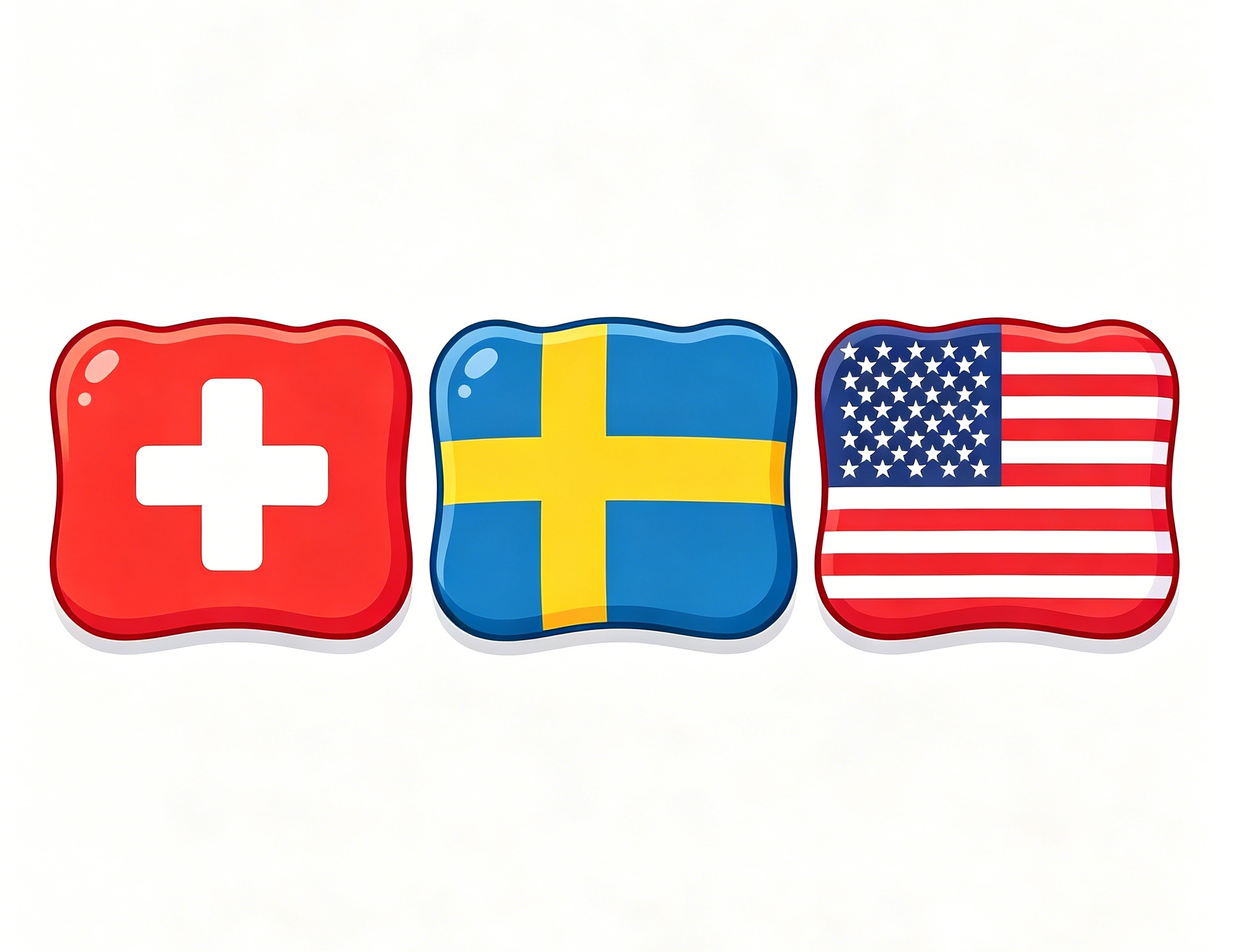
At2025National Innovation Ranking (GII) ranking, Switzerland has continuously 15 RankedGIISweden and the United States rank second and third, respectively. These three nations are considered Tier 1 innovators. They share common strengths: high R&D investment, world-class education and research institutions, dense innovation clusters, strong intellectual property protection awareness, and high-quality outputs. However, they differ fundamentally in their core innovation models.
1.
Key Differences in Innovation Investment
|
Comparison Criteria |
Difference Explanation |
|
Policy |
Switzerland: Strongest asset monetization; Sweden: Focus on social equity; United States: Optimal capital and market dynamics. |
|
Human Capital and Research |
Switzerland: Artisan + Scientific collaboration; Sweden: Everyone's involvement+Balanced distribution; United States: Elite-led+Breakthrough |
|
Infrastructure |
Switzerland: Balanced, not extreme; Sweden: Green + Benchmark for Digital Infrastructure; United States: Largest Scale of Tech Infrastructure |
|
Market Maturity |
Switzerland: Long-term capital, stability-focused; Sweden: Inclusive capital, socially collaborative; United States: Capital-driven, most dynamic ecosystem |
|
Commercial Maturity |
Switzerland: Lean expertise, closed-loop production and R&D; Sweden: Systemic collaboration, innovation for all; United States: Giant-led, open ecosystem |
2. Core Differences in Innovation Output
|
Comparison Criteria |
Difference Explanation |
|
Knowledge and Technical Outputs |
Switzerland: High-End Manufacturing + Monetizing pharmaceuticals; Sweden: Green Technology + Inclusive Applications; U.S.: Disruptive Technologies + Global Standard |
|
Creative Output |
Switzerland: Precision Design + Premium brand; Sweden: Minimalist design + Green Brand; USA: Popular Culture + Tech Brand |
3. Fundamental Differences in Innovative Models
- Switzerland: Balanced Lean Model – Small, Beautiful, and Uncompromising Quality
- Features: No weak points in investment, top-tier output quality, deep integration of product and R&D, and a concentration of specialized and new enterprises.
- Advantages: Achieves world-class excellence in a compact footprint. Global leader in monetizing intellectual property, high-end manufacturing, and precision innovation capabilities.
- Ideal for small, developed economies with limited resources, high-end positioning, and export-oriented strategies.
- Sweden: Inclusive and collaborative model—large-scale, equitable, and green-oriented
- Features: Social equity, universal participation, green innovation, and system synergy. World-leading infrastructure and commercial maturity.
- Advantages: Global leadership in R&D personnel density, green technology, SME innovation, and employment in knowledge-intensive industries.
- Ideal for high-welfare economies prioritizing balanced development, social well-being, and sustainable innovation.
- United States: Capital-ecosystem driven; large-scale, powerful, and risk-driven
- Key Features: Market- and capital-driven, led by industry giants, largest cluster scale, strongest frontier breakthroughs.9 Top-ranked globally in sub-indicators.
- Advantages: Venture capital, university research influence, cutting-edge technology (AI /chips), with the most active global innovation ecosystem.
- Ideal for: Large economies pursuing technological dominance, commercial success, and global influence.
Switzerland follows a path of quality and specialization, Sweden embraces an inclusive and green approach, and the United States pursues capital-driven and cutting-edge innovation; together, these three models define the leading tier of global innovation.